
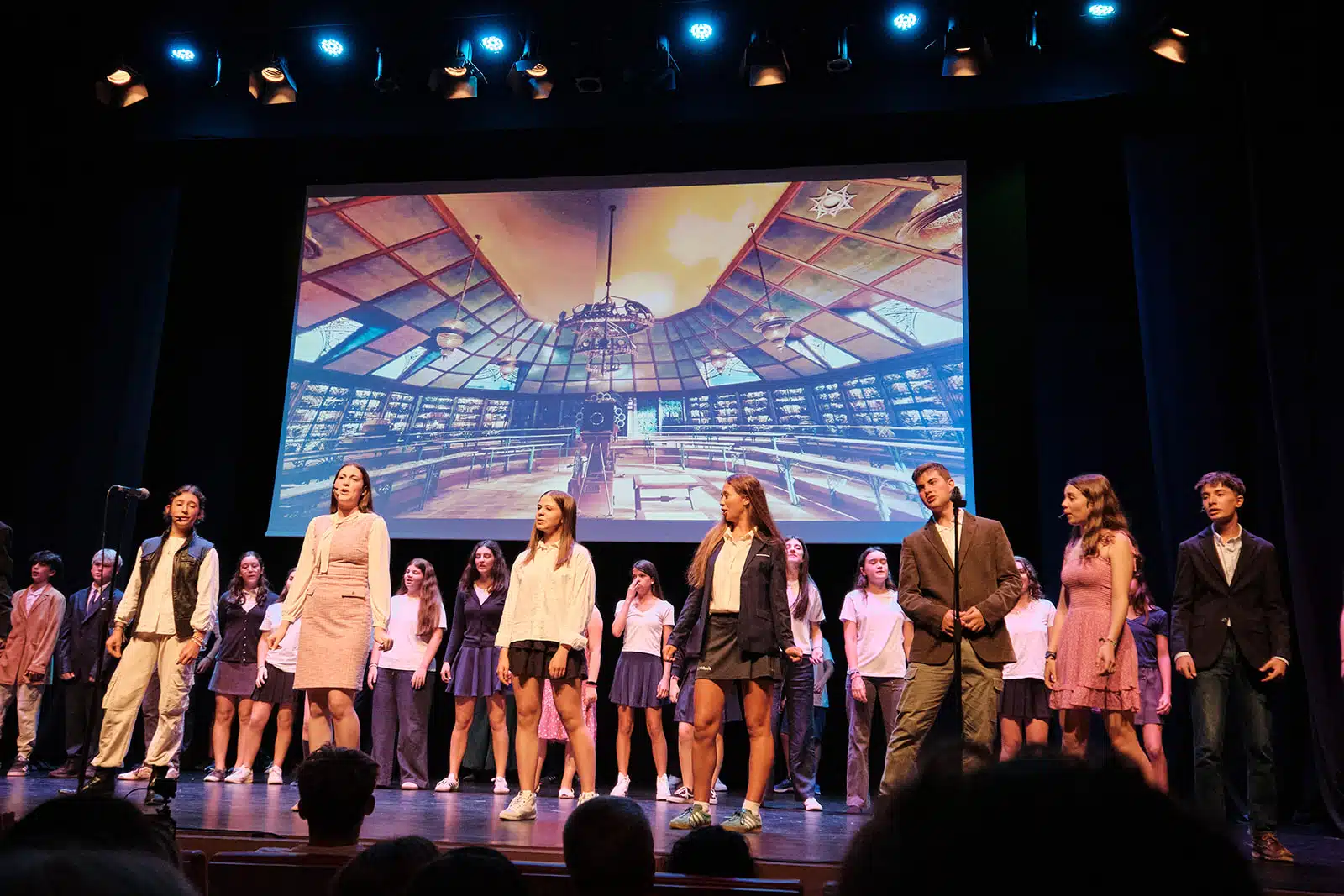
“One of the safest places to be in the world is the stage.” This insight by Frank Langella captures something essential about learning: it involves stepping forward, experimenting, making mistakes, and growing through experience.
In Santiago de Compostela — a city where cultural heritage meets an international outlook — at Chester College International School, performing arts are a core part of education. Music, theatre and dance are not treated as extras, but as meaningful tools that support students throughout the academic year and in our international summer camps.
What research tells us
Educational research increasingly supports the role of theatre and drama in child development.
A study led by Dr Natasha Kirkham at the Centre for Brain and Cognitive Development at Birkbeck University of London explored the impact of live theatre on children and teenagers.
Key findings include:
- Improved academic performance
Engagement with drama can increase average academic performance by around 4%. - Greater empathy and social awareness
Live theatre fosters deeper understanding than screen-based content, enhancing tolerance and critical thinking. - Stronger emotional and cognitive development
Students develop skills to interpret emotions and navigate complex situations. - Confidence to explore challenging topics
Theatre provides a safe space to approach social and personal issues.
Students who attended live performances also scored higher in comprehension, social perspective and content understanding than those who only watched film adaptations.
Learning languages through performing arts
These benefits become especially powerful in the context of language learning.
In our international summer camps in Spain, performing arts offer a natural and immersive way to learn English or Spanish. Preparing a musical or theatre production goes far beyond memorising lines:
- Students practise vocabulary in real context
- Improve pronunciation, diction and fluency
- Gain confidence speaking in front of others
- Overcome fear of communication
- Develop teamwork and creativity
Performing on stage in another language changes how students relate to it. Afterwards, everyday communication feels much more natural.
More than an extracurricular activity
Performing arts connect academic learning with emotional understanding. They are not just about content, but about expression, interpretation and human connection.
As Dr Kirkham highlights, theatre helps young people:
- build social bonds
- explore emotions safely
- develop skills for navigating a complex world
Integrating music, drama and dance into both school life and summer programmes reflects a deeper understanding of how meaningful learning happens.
Explore further
If you would like to learn more about how performing arts are part of our educational approach: